Apple is betting that the value created by AI will shift from models themselves to interfaces, distribution and ecosystems.
The extraordinary reach of Apple’s products, brand and ecosystem speaks to the company’s strategic foresight, particularly when considering how long it has remained a leader in its markets.
Yet the history of technology hardware is littered with companies that rose to prominence, dominated their markets and eventually faded or disappeared. DEC, Sun Microsystems, Compaq, Ericsson, Motorola, Palm, BlackBerry and Nokia were all once considered untouchable innovators or market leaders. They weren’t. For different reasons, they all eventually lost their mojo.
Apple’s downfall has been predicted many times. Yet the company continues to defy the sceptics, while the appeal of its products remains remarkably strong. Against the odds, it has ranked among the world’s five largest listed companies by market capitalisation since 2009, navigating the rise of cloud computing, social media, streaming, e-commerce, SaaS and now generative AI.
Innovation Does Not Always Mean Being First
Apple has shown that a technology company can remain at the forefront without pioneering every new category.
It did not invent the smartphone, the tablet, the personal computer, wireless earbuds or the smartwatch. Yet it has built leading positions across all of them. Again and again, Apple has waited for technologies to mature, costs to fall and consumer use cases to become clearer before delivering an integrated product.
In many ways, the company’s history has been about turning innovation into profitable mass-market products.
That philosophy also helps explain Apple’s AI strategy in today’s frantic race to build AI infrastructure. While hyperscalers are committing enormous amounts of capital, Apple has deliberately stayed largely on the sidelines. The reasoning is becoming easier to understand.
Apple AI Strategy: Playing a Different Game
What do the hyperscalers sell?
Cloud services, advertising, computing power and increasingly AI subscriptions.
Apple, by contrast, primarily sells iPhones, Macs, AirPods and a growing range of services tied to its ecosystem. The question management may be asking is therefore not,“Do we have the best-performing LLM?” but rather,“Can every major LLM be made available through our products and make those products more valuable?”
The company has one enormous advantage: distribution.
With around two billion active devices, including more than one billion iPhones, Apple already has what most AI companies ultimately want: direct access to users.
This may help explain what otherwise looks like a surprising valuation gap. Apple trades at close to 37 times estimated 2027 earnings, compared with approximately 25 times for Microsoft and 16 times for Nvidia.
What If LLMs Become Commodities?
Look more closely, however, and the gap begins to make sense.
Investors appear to be betting on the gradual commoditisation of large language models. As the capabilities of ChatGPT, Gemini, Claude and competing models converge, value could migrate towards the user interface, proprietary data, ecosystems and hardware. These are areas where Apple already holds significant advantages.
In that scenario, Apple could effectively rent AI capacity just as it buys components from Samsung or TSMC. It would not need to win the infrastructure race to capture part of the value created by it.
This approach is currently being rewarded by equity markets, but it is not without risk.
If AI becomes the new operating system, if conversational interfaces replace applications, or if users increasingly access digital services through autonomous agents rather than iOS, Apple could face the same kind of strategic disruption that confronted Nokia and BlackBerry when the smartphone emerged.
Who Will Capture the Value of AI?
Apple is behaving as though AI will eventually become a commodity. The hyperscalers are investing as though it will remain a scarce and strategically valuable resource.
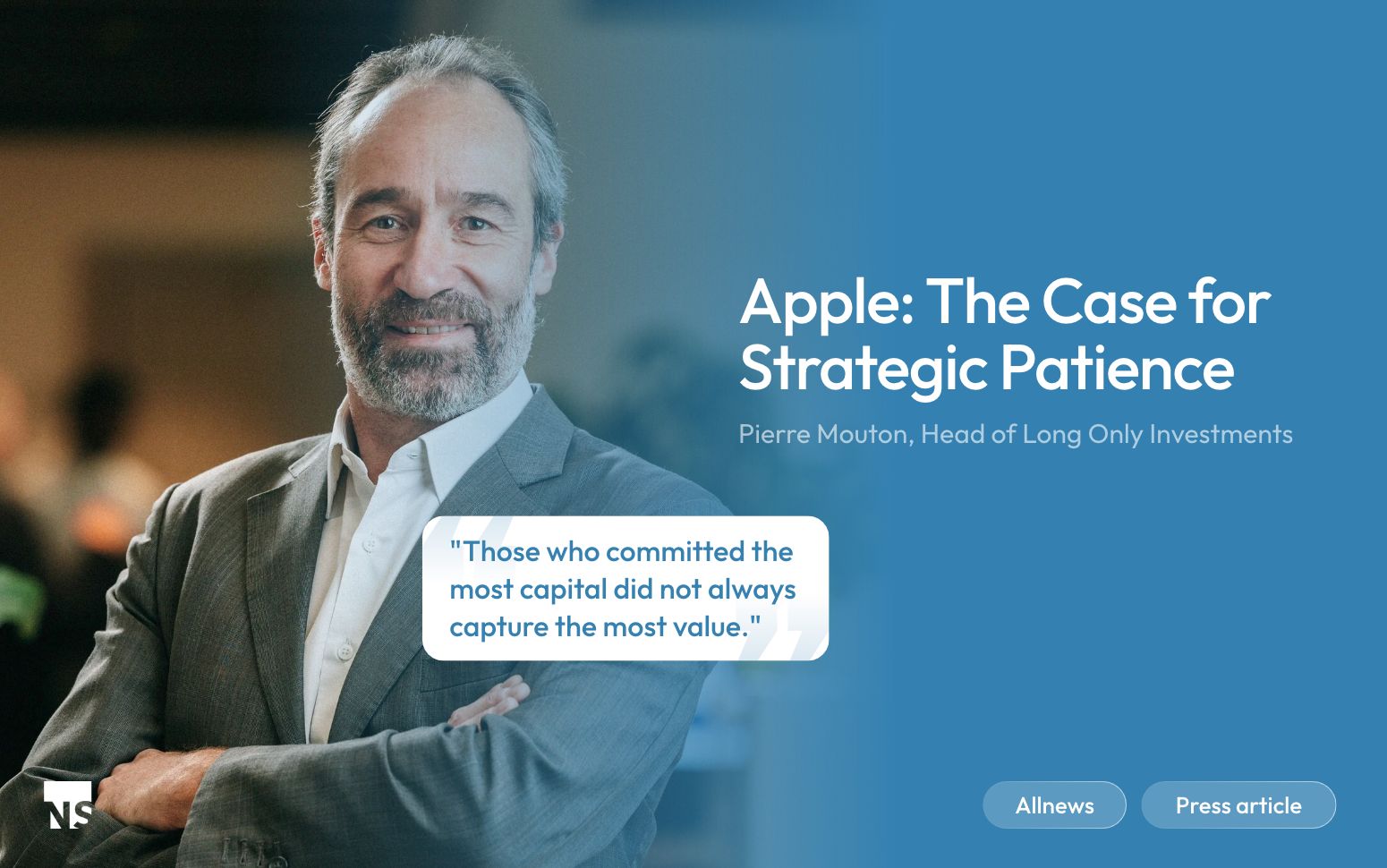
For now, markets side with Apple, assigning the company an optimistic valuation. Investors may also remember the lessons of previous investment cycles, from nineteenth-century railways to fibre-optic networks in the 1990s and 3G telecommunications infrastructure in the early 2000s. Those who committed the most capital did not always capture the most value.
China’s entry into the AI race could further intensify pressure on margins for model providers.
Apple’s bet is ultimately one of strategic patience: let others finance the technological race while preserving access to what may matter most in the end: the user.
Written by Pierre Mouton
Read the original French article published in AllNews:
All News | Apple, la stratégie de la prudence
Past performance is not indicative of future results. The views, strategies and financial instruments described in this document may not be suitable for all investors. Opinions expressed are current opinions as of the date(s) appearing in this material only. References to market or composite indices, benchmarks or other measures of relative market performance over a specified period of time are provided for your information only. NS Partners provides no warranty and makes no representation of any kind whatsoever regarding the accuracy and completeness of any data, including financial market data, quotes, research notes or other financial instruments referred to in this document.
This document does not constitute an offer or solicitation to any person in any jurisdiction in which such offer or solicitation is not authorized or to any person to whom it would be unlawful to make such offer or solicitation. Any reference in this document to specific securities and issuers are for illustrative purposes only, and should not be interpreted as recommendations to purchase or sell those securities.
References in this document to investment funds that have not been registered with the Finma cannot be distributed in or from Switzerland except to certain categories of eligible investors. Some of the entities of the NS Partners group or its clients may hold a position in the financial instruments of any issuer discussed herein, or act as advisor to any such issuer.
Additional information is available on request.
© NS Partners Group