
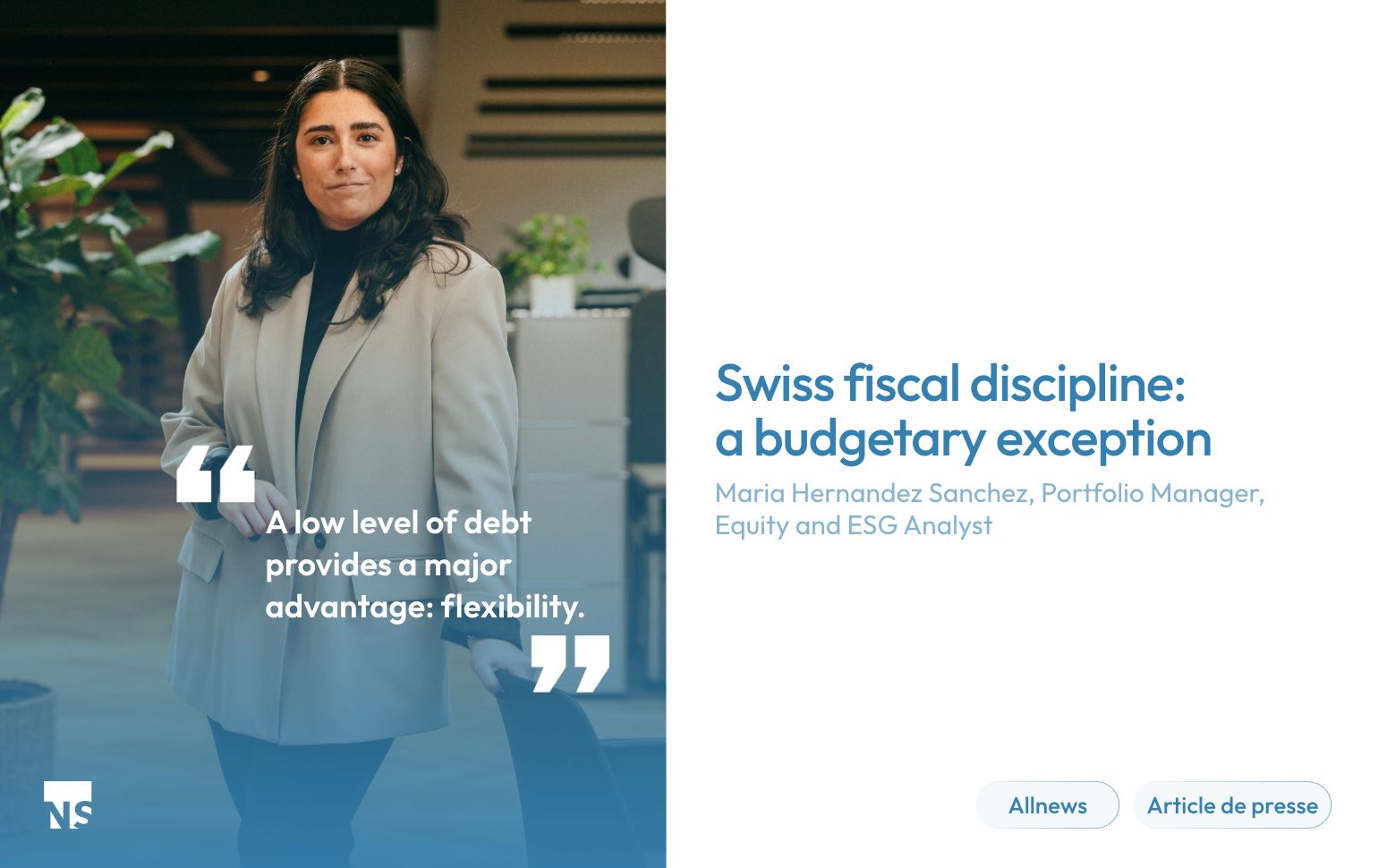
Swiss Fiscal Discipline: An Exception in an Indebted World
How sound public finances, democratic accountability and strong institutions have helped Switzerland build one of the world’s most resilient economies.
At a time when rising public debt has become one of the major economic challenges facing the developed world, Switzerland stands apart. While many advanced economies continue to deal with the legacy of financial crises, pandemic-related spending and expanding fiscal commitments, Switzerland has maintained one of the strongest public balance sheets globally.
For investors, this is more than a favourable economic indicator. It is one of the foundations of Switzerland’s safe-haven status, alongside political stability, strong institutions, competitive businesses and the enduring strength of the Swiss franc.
Switzerland’s Low Public Debt Sets It Apart
According to the Swiss Federal Department of Finance, federal debt stood at CHF 140 billion at the end of 2025, equivalent to just 16.1% of GDP. At a time when debt-to-GDP ratios above 80%, or even 100%, have become commonplace, Switzerland’s fiscal position clearly stands out.
This performance rests on an institutional framework designed to limit excessive borrowing while preserving the government’s ability to respond in times of crisis.
At the heart of this framework is Switzerland’s debt brake, a constitutional fiscal rule approved by Swiss voters in 2001 and implemented in 2003.
The mechanism requires public expenditure and revenues to remain balanced over the economic cycle. During periods of expansion, surpluses help reduce debt. During downturns, temporary deficits are permitted, giving the government room to support the economy.
Fiscal Discipline Creates Room to Act
The results have been striking.
Over the past two decades, Switzerland has navigated the global financial crisis, the European sovereign debt crisis and the COVID-19 pandemic while maintaining one of Europe’s lowest levels of public debt. Even after exceptional pandemic-related spending, Swiss public finances remained significantly stronger than those of most developed countries.
Low debt provides another important advantage: flexibility.
Highly indebted governments often face difficult trade-offs between supporting economic growth, financing public services and maintaining market confidence. Switzerland has considerably more room to manoeuvre when unexpected challenges arise. This fiscal discipline is reinforced at cantonal level, where many cantons operate under their own rules designed to maintain sound public finances.
The Investment Case for Swiss Fiscal Discipline
The benefits are reflected in Switzerland’s exceptionally low cost of capital. Swiss 10-year government bonds have historically offered some of the lowest yields in the developed world, reflecting investor confidence in the sustainability of the country’s public finances. Swiss companies also benefit from favourable financing conditions, supporting investment, innovation and competitiveness.
Switzerland’s resilience extends beyond its public finances. Despite having a population of fewer than ten million, the country is home to global leaders including Roche, Novartis, Nestlé and Richemont, as well as one of the world’s major financial centres. The Swiss franc has retained its safe-haven status, supported by political stability, institutional credibility and a long tradition of prudent economic management.
Perhaps most notably, this framework exists within a system of direct democracy.
Major fiscal reforms often require voter approval, giving long-term policies a high degree of legitimacy. The debt brake illustrates Switzerland’s ability to build durable consensus around fiscal responsibility. At a time when persistent public deficits have become commonplace, Switzerland shows that economic prosperity and fiscal discipline can coexist, offering investors a valuable source of stability in an increasingly uncertain global environment.
Written by Maria Hernandez Sanchez
Read the original French article published in AllNews:
All News | La discipline budgétaire suisse, une exception fiscale
Past performance is not indicative of future results. The views, strategies and financial instruments described in this document may not be suitable for all investors. Opinions expressed are current opinions as of the date(s) appearing in this material only. References to market or composite indices, benchmarks or other measures of relative market performance over a specified period of time are provided for your information only. NS Partners provides no warranty and makes no representation of any kind whatsoever regarding the accuracy and completeness of any data, including financial market data, quotes, research notes or other financial instruments referred to in this document.
This document does not constitute an offer or solicitation to any person in any jurisdiction in which such offer or solicitation is not authorized or to any person to whom it would be unlawful to make such offer or solicitation. Any reference in this document to specific securities and issuers are for illustrative purposes only, and should not be interpreted as recommendations to purchase or sell those securities.
References in this document to investment funds that have not been registered with the Finma cannot be distributed in or from Switzerland except to certain categories of eligible investors. Some of the entities of the NS Partners group or its clients may hold a position in the financial instruments of any issuer discussed herein, or act as advisor to any such issuer.
Additional information is available on request.
© NS Partners Group