Chart of the Month: Does the Traditional Fund of Funds Model Still Have a Future?
does the traditional fund of funDs model still have a future?
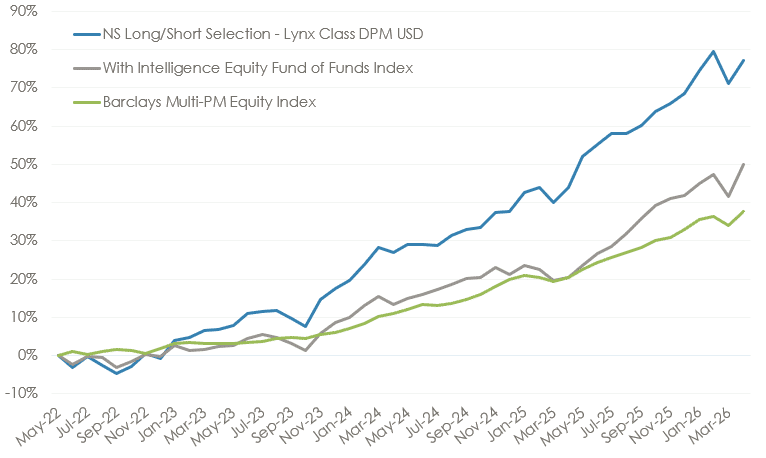
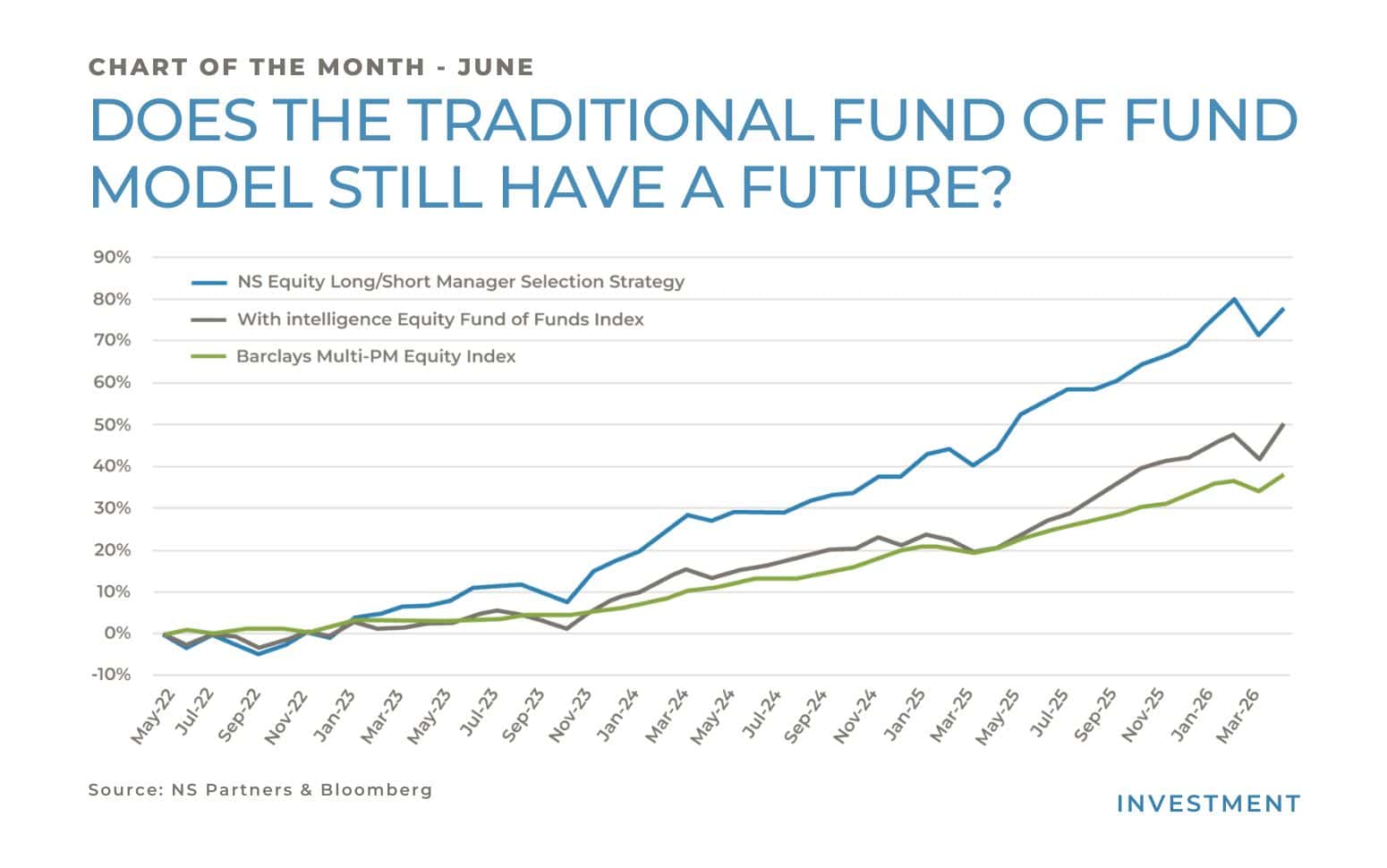
Comparison of equity long/short strategy performance versus equity fund of funds peers index and the Barclays Multi-PM Equity Index over four years.
As a firm, NS Partners has been involved in managing fund of hedge funds strategies for almost 57 years. Back in the 1990s, almost every private bank in Switzerland managed its own fund of funds for clients. At the time, it was relatively easy to generate double-digit returns: there were fewer hedge funds (and therefore less competition), while regulation remained light. The introduction of Regulation Fair Disclosure (Reg FD) in 2000 marked the end of the “fast money” era.
Given their success, many fund of funds became too large and suffered from the classic “diworsification” syndrome, which subsequently led to sub-par returns. Fast forward to today and most traditional fund of funds have disappeared, having largely been cannibalized by pod shops. The liquidation of Leverage Capital Holdings, one of the world’s oldest hedge fund of funds, in 2025 is a sign of the times.
Today, most investors have gravitated towards the multi-strategy pod-shop model, which has proven more efficient at allocating capital and cutting losses, despite being significantly more expensive than the traditional fund of funds approach. Others have turned to tailored hedge fund solutions offered by private banks.
With hedge fund assets at an all-time high, the number of new fund launches has steadily declined over the last 20 years. This highlights how the billion-dollar club of hedge funds continues to grow, attracting an ever-increasing share of industry assets.
As we all know, performance is typically inversely correlated with growth in assets under management. More importantly, the strongest portion of a manager’s track record is often generated during the first three to five years after inception—the very period before most institutional investors are willing to allocate capital.
At NS Partners, we have a long and proven history of backing hedge fund managers in their early innings, particularly in the equity long/short space. This has enabled us to build strong partnerships over time, often resulting in capacity rights, preferential fees and attractive liquidity terms. As a result, a concentrated fund of funds strategy can remain highly competitive compared with alternative hedge fund structures.
It is worth remembering that George Soros launched the Quantum Fund with a 1% management fee and a 10% performance fee. Somehow, 2%/20%—and often considerably more once pass-through costs are included—became the industry norm.
This month’s chart illustrates the performance of our equity long/short strategy over the last four years versus the average equity long/short fund of funds and the Barclays Multi-PM Equity Index over the same period.
So What Options Are Left in Today’s World of Hedge Fund Alternatives?
The Advisory Mandate
- Buy high and sell low (everyone chases past performance—that’s human nature), making underperformance versus a concentrated fund of funds strategy highly likely.
- Access to the best talent is often limited by capacity constraints.
- Rarely invests alongside managers at an early stage.
- Layered fee structures.
The Pod-Shop Model
- Attractive risk-adjusted returns, although the most successful platforms are often capacity constrained.
- Significant use of leverage, sometimes excessive.
- Large numbers of underlying portfolio managers (often 100+) with the strongest contributors becoming less scalable over time.
- Factor hedging can be detrimental to performance, particularly over the last two years.
- High barriers to exit through both investor- and fund-level gates.
- End investors can surrender more than 55% of gross performance through pass-through cost structures.
- Often exposed to pod deleveraging events that can impair performance.
The Quant-Shop Model
- High turnover and short investment horizons (from intraday to approximately 30 days), which have benefited recent performance.
- Constant need to reinvent investment signals due to crowding and signal decay.
- Frequently employs even more leverage than pod shops.
- Investors rarely know precisely when or why losses occur (e.g., the “Quant Winter” from 2018 to 2020).
- Relies primarily on algorithms with limited human intervention.
The Traditional Directional Fund of Funds Strategy
- Low-cost, high-conviction portfolio of managers (12 remains the lucky number).
- Backs managers before they reach the pinnacle of their careers.
- Provides access to managers whose minimum investment requirements often range from USD 1 million to USD 25 million.
- Liquid, with no investor-level gates that can delay capital returns for years.
- Uses less leverage.
- Highly difficult to replicate through an advisory mandate.
With pod shops and quant shops dominating market share today, perhaps it is time to revisit a less crowded and more focused fund of funds approach—one built around capacity-constrained managers with longer investment horizons.
The old-school approach of making directional equity bets with conviction, accepting that difficult years are inevitable, and relying on a disciplined long-term investment horizon may ultimately prove more rewarding than chasing year-to-date performance. Every strategy experiences setbacks, but a well-constructed short book can provide valuable protection along the way.
Beat Notz, our founding partner, is often quoted in research pieces published by Gavekal, a business he backed in the 1970s when it was known as Cecogest and was founded by Charles Gave:
Remember, it’s an easy business. When things get complicated, and markets are all over the place, just bear in mind that the Fed will always follow policies that benefit equity holders, because everyone in the US owns equities, and the Bundesbank will always follow policies that benefit bund holders, because everyone in Germany owns bunds. So, when markets are panicking and you don’t know what to do, just buy equities in the US and buy bunds in Germany.
Although bunds no longer exist, he was right about equities.
Written by CARON BASTIANPILLAI
Download PDF version Chart of the Month – Does the Traditional Fund of Funds Model Still Have a Future?
This content is provided for information purposes only and does not constitute investment advice, an offer, solicitation or recommendation to buy or sell any financial instrument or investment product.
The views and opinions expressed are those of NS PARTNERS SA at the date of publication and may change without notice. References to specific securities, sectors or market developments are provided for illustrative purposes only and should not be interpreted as investment recommendations or investment research.
Past performance does not predict future returns. The value of investments and the income derived from them may fluctuate and investors may not recover the amount originally invested. Investments involve risks, including possible loss of capital.
References to market indices, benchmarks or other measures of relative market performance are provided for information purposes only. NS PARTNERS SA makes reasonable efforts to ensure the accuracy of the information contained herein but provides no warranty or representation as to its completeness or accuracy.
Some entities of the NS Partners Group or their clients may hold positions in the financial instruments mentioned or may act as advisor to related issuers.
This content may not be distributed or used in any jurisdiction where such distribution or use would be contrary to local laws or regulations. Additional information is available upon request.
© NS Partners Group
Article tagged by: