Chart of the Month: China’s Hidden AI Advantage

China’s Hidden AI Advantage
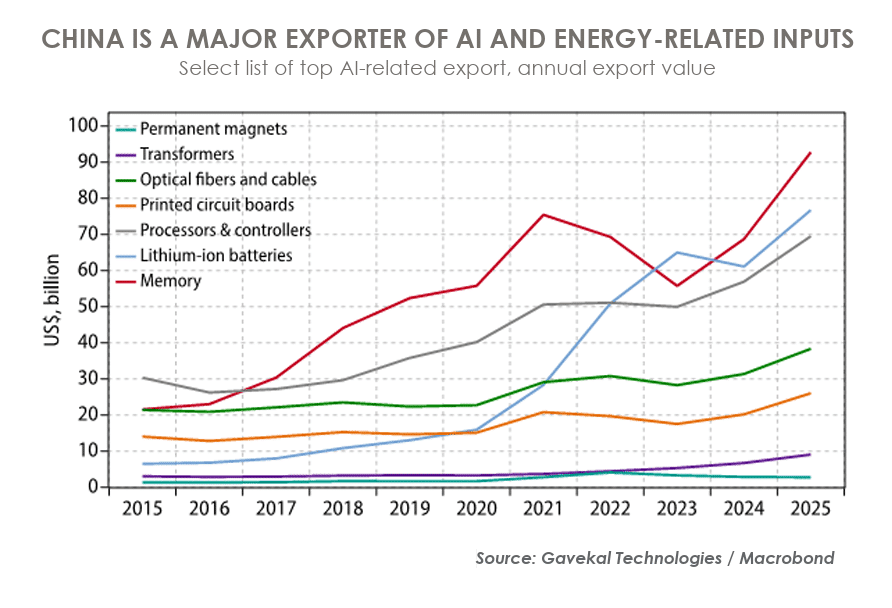
Chinese manufacturers are key suppliers of components required for data centres, electricity networks and AI infrastructure. Source: Gavekal Technologies / Macrobond.
Artificial Intelligence is often viewed through the lens of software companies, advanced semiconductors and frontier AI models. Yet one of the most underappreciated consequences of the AI revolution is the unprecedented demand for physical infrastructure.
As AI adoption accelerates and data centres expand around the world, the beneficiaries extend far beyond the developers of AI models themselves. Increasing computing requirements are creating significant demand for electrical equipment, networking components, cooling systems, batteries and energy infrastructure. This month’s Chart of the Month highlights an important investment theme: the global AI boom is creating substantial opportunities for Chinese manufacturers positioned across the infrastructure value chain.
The Infrastructure Behind Artificial Intelligence
The construction of AI-ready data centres requires enormous quantities of equipment and industrial inputs. Power infrastructure, cooling technologies, networking components, printed circuit boards, batteries, industrial automation systems and precision manufacturing equipment all play a critical role in supporting next-generation computing capacity.
Many of these segments are areas where Chinese companies have developed significant production capacity and global market share. As a result, even if China does not dominate the most advanced AI models, it is well positioned to capture value from the infrastructure buildout required to support the AI revolution.
Financial Markets Are Recognising the Opportunity
The scale of this opportunity is reflected in current investment plans.
Industry estimates suggest that global spending on AI-related infrastructure will reach hundreds of billions of dollars in the coming years as major technology companies continue to invest aggressively in computing capacity. Companies such as Microsoft, Amazon, Google and Meta are expanding their infrastructure footprints to support growing demand for AI-powered applications and services.
Importantly, this trend extends beyond advanced semiconductors. The expansion of AI infrastructure creates demand for a broad range of industrial products, including power distribution systems, cooling technologies, electrical equipment, grid components and energy solutions. Consequently, a much wider group of businesses stand to benefit from the global AI investment cycle.
Energy: A Critical Component of the AI Boom
One of the most important dimensions of AI infrastructure is energy.
AI workloads consume significantly more electricity than traditional computing applications, increasing demand for grid upgrades, power transmission, renewable energy assets and energy storage solutions. This is particularly relevant for China, which has established leadership positions in batteries, solar panels, electrical equipment and power electronics.
As governments and corporations invest to meet rising electricity demand generated by AI applications, these industries could experience sustained growth. The AI investment cycle therefore extends well beyond software and overlaps closely with several of China’s core industrial strengths.
A Broader AI Ecosystem
The chart also illustrates a broader shift in the technology landscape.
Historically, technological breakthroughs often generated the greatest benefits for innovation leaders. In the AI era, however, value creation is distributed across a much larger ecosystem involving both software and hardware providers. Every AI model ultimately relies on physical infrastructure for training, deployment and operation.
This creates what could be considered a second-order AI opportunity: investing not only in the companies developing artificial intelligence, but also in the businesses supplying the equipment required to power it.
Perhaps most importantly, this theme remains relatively resilient to uncertainty about which AI models ultimately emerge as market leaders. Whether future demand is captured by OpenAI, Anthropic, Google, xAI, DeepSeek or future entrants, the underlying requirement remains the same: more servers, more electricity, more cooling capacity, more networking equipment and more industrial infrastructure. Chinese manufacturers occupy strategic positions across many of these supply chains and may therefore benefit regardless of which AI developers ultimately prevail.
Looking Beyond Software
The AI revolution is not solely a software story.
Behind every breakthrough model lies a vast industrial ecosystem responsible for building and maintaining the physical infrastructure that makes artificial intelligence possible. As the next phase of AI development shifts from experimentation to large-scale deployment, manufacturers supplying the foundations of the digital economy may emerge among the most significant beneficiaries.
The global AI race is therefore not just about algorithms and semiconductors. It is increasingly about factories, supply chains, electrical infrastructure and industrial capacity.
Written by Gabriele Casati
Download PDF version Chart of the Month – China’s Hidden AI Advantage
This content is provided for information purposes only and does not constitute investment advice, an offer, solicitation or recommendation to buy or sell any financial instrument or investment product.
The views and opinions expressed are those of NS PARTNERS SA at the date of publication and may change without notice. References to specific securities, sectors or market developments are provided for illustrative purposes only and should not be interpreted as investment recommendations or investment research.
Past performance does not predict future returns. The value of investments and the income derived from them may fluctuate and investors may not recover the amount originally invested. Investments involve risks, including possible loss of capital.
References to market indices, benchmarks or other measures of relative market performance are provided for information purposes only. NS PARTNERS SA makes reasonable efforts to ensure the accuracy of the information contained herein but provides no warranty or representation as to its completeness or accuracy.
Some entities of the NS Partners Group or their clients may hold positions in the financial instruments mentioned or may act as advisor to related issuers.
This content may not be distributed or used in any jurisdiction where such distribution or use would be contrary to local laws or regulations. Additional information is available upon request.
© NS Partners Group
Article tagged by: