Rise of Luxury Experiences: Why Travelers Are Choosing Memories Over Material Goods

Rise of Luxury Experiences: Why Travelers Are Choosing Memories Over Material Good
Luxury spending has long been associated with the purchase of high-end products such as designer handbags, watches and jewellery. Yet consumer preferences are evolving. Increasingly, luxury is being defined not only by what people own, but by what they experience. Travel, wellness, personalised services and cultural enrichment have become powerful drivers of spending among affluent consumers.
Since the pandemic, this shift has accelerated. Travellers are placing greater value on meaningful experiences, personal well-being and memorable journeys. Luxury tourism revenues have already surpassed pre-pandemic levels, supported by strong demand for premium hotels, cruises and wellness retreats. Industry estimates suggest that the global luxury travel market reached approximately $1.6 trillion in 2025 and is expected to continue growing at high-single-digit rates for the foreseeable future.
Financial Markets Are Reflecting the Trend
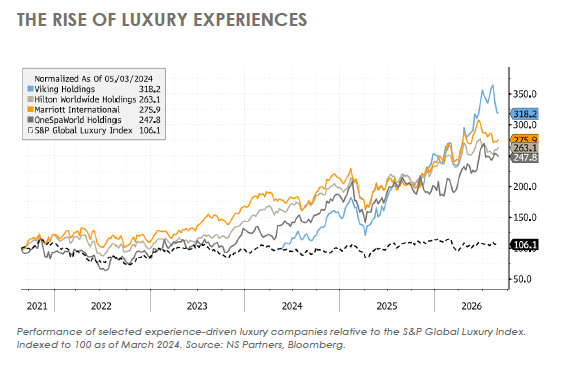
The impact of this shift extends beyond consumer behaviour and is increasingly visible in financial markets. As illustrated in this month’s chart, companies exposed to luxury travel, hospitality and wellness experiences have significantly outperformed the broader luxury sector over the past two years, suggesting investors are recognising the strength and durability of this structural trend.
Viking Holdings: Travel as an Experience
One of the clearest beneficiaries of this trend is Viking Holdings. Unlike traditional cruise operators focused on mass-market entertainment, Viking has built its brand around destination-focused travel experiences designed for affluent travellers seeking enrichment and discovery.
The company reported revenue growth of nearly 22% in 2025, reaching $6.5 billion, while maintaining occupancy levels of around 95%. To address rising demand, Viking plans to add 27 new river ships by 2028 and 10 additional ocean ships by 2031. These investments reflect management’s confidence that demand for experiential and destination-oriented travel will remain strong.
Premium Hospitality Continues to Expand
The same trend can be observed across the luxury hotel industry.
Hilton now operates more than 500 luxury properties across brands including Waldorf Astoria, Conrad and NoMad, while continuing to expand its flagship destinations in key markets. Marriott, through brands such as Ritz-Carlton, St. Regis and JW Marriott, continues to benefit from strong global demand for premium accommodation and exclusive travel experiences. With nearly 1.8 million rooms worldwide and more than 600,000 rooms in its development pipeline, Marriott is investing heavily to capture future growth.
Both companies have highlighted a growing preference for personalised service, exclusive destinations and memorable experiences as travellers choose to spend more on unique journeys and premium hospitality.
Wellness Becomes a Core Luxury Category
Beyond transportation and accommodation, wellness has become one of the most important pillars of the luxury experience economy.
This creates a significant opportunity for OneSpaWorld, the leading provider of wellness services onboard cruise ships and at resort destinations. The company operates more than 200 wellness centres, serves over 28 million cruise guests annually and controls more than 90% of the outsourced maritime wellness market. In 2025, OneSpaWorld generated record revenue of approximately $961 million, supported by growing demand for fitness programmes, nutrition services, medi-spa treatments and broader wellness-focused experiences.
Perhaps most importantly, wellness is increasingly viewed as an integral component of luxury travel rather than an optional add-on. Consumers are seeking experiences that contribute not only to enjoyment, but also to personal well-being.
The Future of Luxury
Taken together, the success of Viking, Hilton, Marriott and OneSpaWorld highlights a profound shift in luxury consumption.
Luxury goods remain an important part of the market. However, some of the strongest growth is now coming from experiences that offer discovery, wellness and personal enrichment. Both high-net-worth individuals and younger affluent consumers are prioritising travel, cultural experiences and self-care over the acquisition of additional material possessions.
The implication is clear: the future of luxury may be defined less by what people own and more by where they go, what they experience and how those experiences enrich their lives.
Written by Maria Hernandez Sanchez
Download PDF version: Chart of the Month_September 2026
This content is provided for information purposes only and does not constitute investment advice, an offer, solicitation or recommendation to buy or sell any financial instrument or investment product.
The views and opinions expressed are those of NS PARTNERS SA at the date of publication and may change without notice. References to specific securities, sectors or market developments are provided for illustrative purposes only and should not be interpreted as investment recommendations or investment research.
Past performance does not predict future returns. The value of investments and the income derived from them may fluctuate and investors may not recover the amount originally invested. Investments involve risks, including possible loss of capital.
References to market indices, benchmarks or other measures of relative market performance are provided for information purposes only. NS PARTNERS SA makes reasonable efforts to ensure the accuracy of the information contained herein but provides no warranty or representation as to its completeness or accuracy.
Some entities of the NS Partners Group or their clients may hold positions in the financial instruments mentioned or may act as advisor to related issuers.
This content may not be distributed or used in any jurisdiction where such distribution or use would be contrary to local laws or regulations. Additional information is available upon request.
© NS Partners Group
Article tagged by: