Artificial Intelligence is changing the world. But will it change long-term equity market returns?

Artificial intelligence Is Changing the World. But Will It Change Long-Term Equity Market Returns?
Artificial Intelligence is transforming industries, reshaping business models and accelerating productivity across the global economy. Many investors therefore assume that AI will also permanently increase stock market returns. But history tells a more nuanced story. Looking back at previous technological revolutions—from the personal computer and the Internet to cloud computing and smartphones—provides valuable perspective on what AI may, and may not, mean for long-term investors.rtificial Intelligence is transforming industries, reshaping business models and accelerating productivity across the global economy.
Many investors therefore assume that AI will also permanently increase stock market returns. But history tells a more nuanced story. Looking back at previous technological revolutions—from the personal computer and the Internet to cloud computing and smartphones—provides valuable perspective on what AI may, and may not, mean for long-term investors.
Artificial Intelligence Is Changing the World. But Will It Change Long-Term Equity Market Returns?
Since 1976, the S&P 500 has lived through the personal computer (1981), the World Wide Web (1991), the Internet boom (1995), cloud computing (2006), the smartphone revolution (2007), and now Artificial Intelligence (2022).
Each of these innovations changed the world. Consumers benefited enormously. Productivity increased. Entire industries emerged while others disappeared. Joseph Schumpeter described this process as creative destruction: old technologies and business models fade away, new ones take their place, and living standards improve. AI may prove no different.
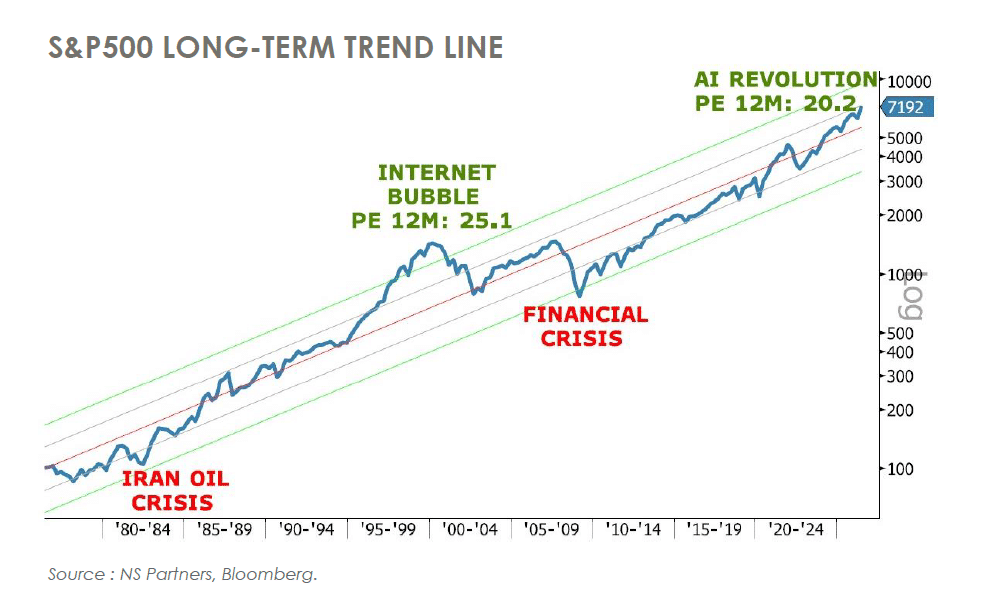
The late 1990s provide a useful reminder. During the dot-com bubble, many investors believed the Internet had permanently changed the rules of investing. In many ways, it did change the economy. The Internet transformed commerce, communication and productivity. Yet after the bubble burst, the S&P 500 gradually returned to its long-term trend, as illustrated in the chart. Few investors would have predicted this outcome in 1999.
At first glance, this may seem counterintuitive. If technological revolutions reshape the economy, why don’t they permanently change the long-term return of the equity market?
The answer is simply Economics 101. A technological advantage attracts competition. Competitors adopt the innovation, barriers to entry gradually decline, and profit margins normalise over time. While a handful of companies may generate extraordinary returns, much of the economic value created by innovation ultimately accrues to consumers through better products, lower prices and higher productivity, rather than to shareholders.
Artificial Intelligence is today’s great technological revolution. It will undoubtedly create winners and losers, disrupt industries and transform the way businesses operate. But for the overall market, history suggests that this time may not be different. The long-term trend of the S&P 500, around 10.5% per year, is already remarkable. Investors should not assume that AI will permanently change the slope of that trend.
Written by ANGEL SANZ
Download PDF version AI Is Changing the World. But Will It Change Long-Term Equity Market Returns?
This content is provided for information purposes only and does not constitute investment advice, an offer, solicitation or recommendation to buy or sell any financial instrument or investment product.
The views and opinions expressed are those of NS PARTNERS SA at the date of publication and may change without notice. References to specific securities, sectors or market developments are provided for illustrative purposes only and should not be interpreted as investment recommendations or investment research.
Past performance does not predict future returns. The value of investments and the income derived from them may fluctuate and investors may not recover the amount originally invested. Investments involve risks, including possible loss of capital.
References to market indices, benchmarks or other measures of relative market performance are provided for information purposes only. NS PARTNERS SA makes reasonable efforts to ensure the accuracy of the information contained herein but provides no warranty or representation as to its completeness or accuracy.
Some entities of the NS Partners Group or their clients may hold positions in the financial instruments mentioned or may act as advisor to related issuers.
This content may not be distributed or used in any jurisdiction where such distribution or use would be contrary to local laws or regulations. Additional information is available upon request.
© NS Partners Group
Article tagged by: